This follows on from a couple of other posts, one about why people always ask “How I Do It?” (short answer: it’s reflexive) and one about the ethical basis for why I don’t answer that question (short answer: counter-intuitively, it leaves them better protected from bad people with ill intent.)
But there is a second, and to me an even more important, reason why I don’t tell people how what I do is what I do.
The second reason, and the main one, is this:
I don’t tell people how I do it because when people see me, they experience something that, in all likelihood, they have only had the opportunity to experience a few times since they were small children.
Remember when?
The closest analogy I’ve found is the Father Christmas moment.
Do you remember how it felt when you first found out that Father Christmas wasn’t, well… you know…?
(Looks around, whispers behind hand: When you found out that Atherfay Istmaschray isn’tay ealray.)
Right from your earliest memories, Father Christmas was magical. Then one day – an older sibling, a kid at school, some suspiciously familiar wrapping paper, a wardrobe you weren’t meant to open – however it happened, you realised what was going on.
Unless you are a bit of a statistical outlier, it was probably deflating, disappointing and possibly even a little traumatic. (Or maybe you are even more of a statistical outlier, and at some point in the future it is going to be very deflating, disappointing and, at this point in your life, exceedingly traumatic.)
After you found out, the magic was gone.
If someone asks how I do it and I start explaining how it works, the fact that they are having their question answered won’t please them, I promise. The experience they had doesn’t get any better. Quite the opposite: it takes on all the fun of a post-mortem.
Why what I do pleases adults so deeply
As adults, we all become very used to understanding how the world works. We learn the rules. We learn the patterns. We learn what’s possible and what isn’t.
And once you’ve been doing that for a few decades, the world starts to feel a bit more… filed and labelled. Even a little dull.
Surprises still happen, of course, but genuine astonishment becomes rarer. Most things have an explanation, and even when you don’t know it, you assume there is one.
That’s why a moment of apparent mind reading lands so hard for grown-ups: it isn’t just “a neat trick” – it’s a brief little wobble in your confidence about what you saw, what you remember, and what you think you know, and the mechanics of the universe in general.
This is where my job becomes a genuine source of joy – both for me, and for the people I perform for.
I get to take people back to a barely remembered state of childhood delight. That “hang on… how is that possible?” reaction swoops down on people, picks them up out of their everyday mindset, and teleports them back into that joyous feeling of wonder and rapturous amazement that they felt so often when they were young.
Why kids often shrug at it
This is why what I do can seem underwhelming to children compared to the reactions I get from adults. Kids are still very used to not understanding how something works.
“You guessed the number I was thinking of? And…? I mean, dude, come on… My dad can work a lawnmower.”
Why young adults are the sweet spot
And yet, slightly counter-intuitively, this is why what I do really plays well for young adults. Better than it does for us proper oldies, anyway, and a lot, lot better than for kids.
I instinctively thought that as I aged, my act would lose its appeal to young adults. That they’d want to see something from someone young and, well, whatever the replacement word for “cool” is these days.
Whereas actually, people in their late teens and their early twenties are the ones who respond the most strongly to what I do.
I think it’s because they’re in the sweet spot. Yes, for the most part they know how the world works. The mental models are built. The sense of wonder isn’t a daily occurrence anymore.
But because they lost it more recently than older adults, they remember that feeling clearly, and so:
- It’s more accessible to them
- They kind of miss it (“Hello, my old friend, where have you been!” they cry)
- Their mental models aren’t as bedded in yet, so there’s still some room for the possibility that truly wonderful stuff might still exist
So, weirdly, as I get older and better at what I do, my act seems to appeal to the (relatively speaking) young even more than it ever did back when I was closer to their age.
What I’m really selling
So no – I don’t tell people how I do it.
If I did, I’d be robbing them of the best bit: that brief, ridiculous, wonderful feeling of reverting to a state of child-like wonder. And as an adult, that feeling is a rare treat.
That’s why, despite our own disappointment at discovering the truth when we were kids, we continue to shop this lie about Father Christmas to our own kids, generation after generation. We love to see them experience the magic and the wonder of it all.
Now that you are all grown up (look at you!), we don’t get this experience of child-like wonder very often in day-to-day life.
If you are lucky, you experience it about once per year.
Steve Jobs was a master of delivering the feeling to tech nerds in his product launches. I like to cite the moment when he pulled an ultra-thin laptop out of a mailing envelope that had been sitting on stage the whole time he was speaking… There had never been a laptop so thin, and Apple nerds the world over totally lost their minds.
For most of the time we’re busy being sensible, being competent, knowing what’s going on… and then, very rarely and just for a few minutes, something happens that your brain can’t immediately file away.
It’s delicious.
And that’s really what I’m selling. Not my “clever skills”. Certainly not “psychic powers” or even “tricks”, really.
I’m selling the feeling of being a kid all over again, for a fleeting few minutes – in a safe, playful way – and then letting you take a little bit of that feeling away with you.
That’s why the parties I work at are so much fun. Because once one person has that hang on… what? moment, it becomes contagious.
People start asking if they can be next. They start comparing notes. They start urging each other to try it. The room gets buzzy in that brilliant way where strangers talk to strangers and everyone’s suddenly got a shared story.
Also – slightly more practically – this is how I make my living.
If I leave people with a sense of wonder (rather than a disappointed sense of “ah, right, I see”), then they remember it, they talk about it, and they tell other people about it.
And that word-of-mouth is where most of my work comes from.
So keeping the mystery intact isn’t just me being precious – it’s good for the event, good for the client, and conveniently good for me too.
So if you ask me “how do you do it?” at an event (which you probably will), I’ll dodge the question while keeping the fun intact. People don’t mind. It was fun, and they were merely asking because they were curious.
They quickly move on to wondering just what was in those fabulous smoked salmon blinis.
So do I honestly never ever tell people?
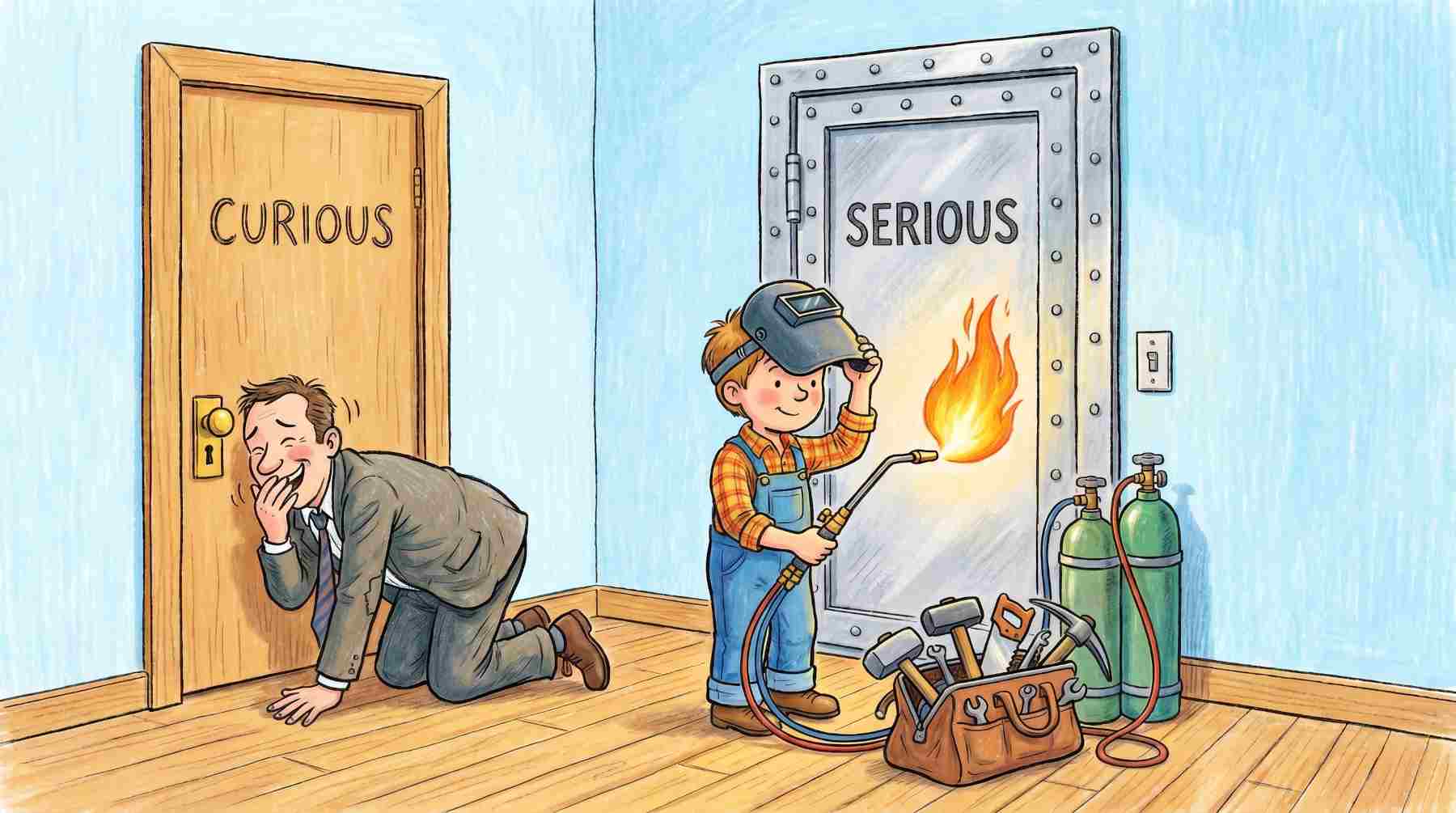
Well, OK. Sometimes I can tell that the question “how did you do that?” isn’t just being delivered in the usual way.
It’s not a “how?” that comes as a knee-jerk reflex. In some cases, the question arrives framed in a slightly different way.
Now and then someone asks in a way that means they’re not just looking for closure – they’re looking for a path.