In a previous post, I explained why people inevitably ask the question “How did you do that?”, why they ask it, and how I deal with it. You can read that post Here
I’m very firm about this: when I’m asked this question, I never disclose my methods. Of course, I don’t bluntly refuse. I just smile and dodge the question, usually by doing something else astonishing. It isn’t because I’m being difficult or because I think I’m some mystical keeper of ancient secrets.
There are a couple of reasons why I don’t tell people how I do what I do. This post will explore the first reason, and I’ll cover the second (and to me, personally, the more interesting one) in another post.
The first is because there are a load of ethical problems that rear their heads when you consider how these techniques are used by people who, unlike me, don’t admit up front that their psychic abilities are a tissue of lies.
The ethical objection
The techniques I use to entertain people are the same family of techniques that fake psychics and fraudulent mediums use to fool people, in order to part them from their money. And to be perfectly frank, if it stops at “they lost some money”, the victims are among the lucky ones.
In many cases, people can go on to be parted from their families, endure many different forms of exploitation, and have their entire lives disrupted and destroyed.
I have some personal experience of this. A friend of mine back in New Zealand was taken in by a con-man using the exact same kinds of techniques that I use today to entertain people. I may tell the story in full at some point, but it ended like this: my friend was utterly captivated by this “amazing” person she had met, and she later lost her life to cancer after following the advice of her “spiritual advisor”.
And it’s important you understand this: people who fall victim to these criminals are not gullible or stupid. I’ve been using these techniques for over 30 years now and I would say that less than 1% of the people who see me use them come even close to guessing the correct answer when they speculate how I might be doing what I do.
“So why not expose it to protect people?”
You might think the best approach would be to publicise these techniques - put the knowledge out there and let people know how it all works. At first glance, that makes a lot of sense, right?
I could call the blog post “Fake Psychics Follow This One Weird Trick To Rip People Off.”
The problem is this: most people aren’t going to sit down and read a long blog post about how fake psychics do it.
Unlike most people, you are here reading this, which suggests you’re either unusually curious… or you’re procrastinating at work. (Possibly both.) Either way, you’re the exception, not the rule, so the vast majority of humans out there wouldn’t be protected by me telling everyone how the whole fake psychic thing is done.
Do you know who would read it, though? Yep. Bad people - people who would use it to do exactly the things I’d be hoping to stop.
Plus, as they say, a little knowledge is a dangerous thing.
Because it’s not just one weird trick that fraudsters use. I have a bookshelf full of books outlining thousands upon thousands of different methods that can be used (and do get used) to fool people. Exposing all of the ways this can be done just isn’t practical.
And even if it was practical, people would need to read it all, and then remember all of it. Forever. Volumes of it. Which ain’t going to happen. People would just end up retaining one, maybe two, half-remembered methods.
And, as I say, a little bit of knowledge is, unfortunately, dangerous.
Let’s consider a political issue such as filling in potholes on the roads, say. If I read an article about the problems with potholes on the roads of Britain in the newspaper, I’ll probably have some opinions as to what Westminster and Local Governments should be doing, and I’ll happily share those opinions loudly whilst down the pub.
However, if I then stand for election locally, get on the local Council and start looking into the matter, I’ll realise that this here pothole issue is a bit trickier than I first thought. There’s the issues of budgets, of sourcing the right people, raw materials, trucks and so on. There’s the issue of water seeping into the road and freezing over winter. There’s prioritisation, and choosing which roads should be fixed in order to minimise damage to people’s cars (or should we aim to minimise disruption to travel times?) and how we manage the fact that potholes can develop quickly and how do we change our plans in response to an evolving situation out on the roads.
And now, with some more knowledge, I might well find that the opinions that I mouthed off about down at the Red Lion, and then used as my platform for being elected to the council, are wrong. The problem wasn’t that I’m stupid. The problem was partly that I didn’t know enough to come up with the right answer for how to fix potholes.
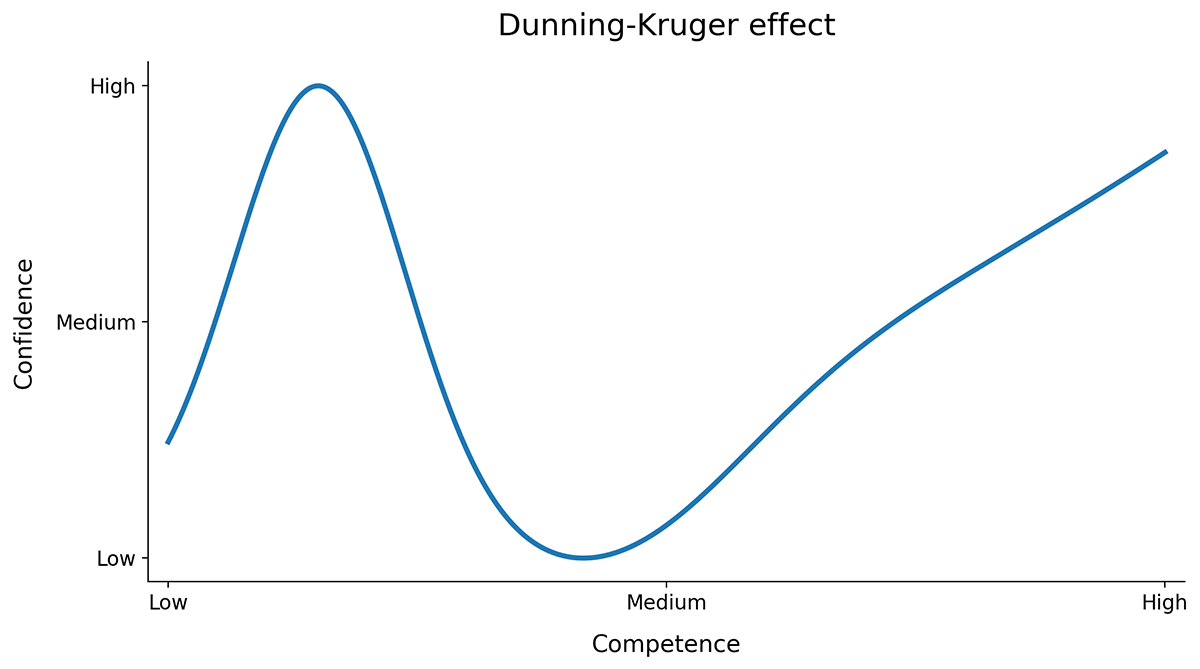
But, most importantly of all, the true problem was that I didn’t know enough about this particular area of expertise to know that I didn’t know enough. Which meant I was over-confident in my ability to fix the problem. I was wrong, but I didn’t know enough to know I was wrong.
This is called the Dunning-Kruger effect. Here’s a little graph* that neatly sums the concept up into an easy to understand visual:
Let’s go back to the idea of teaching people how fake psychics defraud their marks by telling them how it all works. Even if we had a perfectly intelligent person who did read through my entire expose, because this isn’t knowledge they’d be using regularly or keeping updated, the problem is that in a couple of years they would still only have a hazy half-memory of some of it – they’d vaguely be able to recall that fake psychics use a bent paperclip and a piece of string hidden in their trouser pocket** to make it look like they can read minds, for example.
If they meet a con-man who isn’t using that particular method, then they are at even more risk of winding up thinking that this person might be genuine. Because they (think they) know how it’s done by frauds. They read all about it a while back. And this person isn’t doing the stuff they (remember) reading about.
That is not protection. That is a false sense of security.
Why keeping it vague is much safer
If I tell people how it works, two things happen:
- They think they know how fake psychics do it, when in reality they’ve only got the merest inkling.
- More importantly: when they find out that I just used a paperclip and some string**, the amazement deflates instantly, is quickly forgotten and is replaced with disappointment and perhaps a little resentment that they were taken in.
And that second one matters more than you’d think.
If someone, at a very gut level, associates “fake psychics” with disappointment, and then later they meet a fraud who genuinely astonishes them rather than disappoints them, the astonishment doesn’t automatically trigger the thought: “this is probably a trick.” Instead, they reflexively think: “Nope, it can’t be a trick, I met a fake once. He was disappointing. This person? Incredible. Ergo: not a fraud.”
That’s a dangerously easy step for them to take, and one that leads them towards believing.
What I do instead
Instead, I do something that’s more fun and (I think) a stronger defence: I demonstrate that fraud is possible, and I attach the feeling of amazement to the idea that this sort of thing can definitely be faked.
So when someone is reeling at the fact that I just guessed a relative’s name and they ask me how I do it, I generally cheekily deflect with something along the lines of “Well, my job is to make you ask that question - not to answer it…”
But after I deflect with regard to the actual method, I remind them that I said at the beginning that I’m a fake and a fraud, and cheerfully add:
“This is why you should never believe someone who seems to have a message from your dead grandmother…”
That way people hopefully go away with an awareness that yes, even someone like them can be deceived, they associate that with a feeling of genuine astonishment, which fortifies them a little against being banjaxed by someone in future, and they understand a little better that such things are not proof of anything supernatural.
But, most important of all, they’ve gained this knowledge while having a great deal of fun and a lot of laughs.
The Other Big Reason Why I Won’t Tell
The ethics is one reason. But there’s a second reason too, and it’s much simpler. And it’s the bit that makes me love this job of mine so much.
Father Christmas and Why I Keep the Mystery Intact
Even if there were no ethical issues at all, I still wouldn’t tell you.
* Yes, I am aware that, ironically, this graph doesn’t actually represent the Dunning-Kruger effect as per their published paper, and is often used by people who don’t really understand the Dunning-Kruger effect to incorrectly illustrate what the Dunning-Kruger effect is, which, hilariously, kind of proves the graph’s point. My words correctly describe the ideas discussed in the original paper, those of Metacognition (in other words, your knowledge about your knowledge). At least I think they do, I’m no expert, so I might be falling victim to the issue myself. But I’ve bunged the graph in because 1) it gives a (highly oversimplified) visual shorthand for the point I’m trying to make, and 2) I think it’s hilarious how when you Google Dunning-Kruger effect, this graph is what comes up because people felt confident enough in their (lack of) knowledge that they put it on the web. They didn’t know enough about it to realise that they didn’t actually know what the Dunning Kruger effect was. This pleases me enormously. So I’m going to continue to inflict the misunderstanding upon the world, and let it all burn! You can earn extra pedant-points if you’d like by watching a video going into more detail about Dunning-Kruger here
https://www.youtube.com/watch?v=kcfRe15I47I or by reading an article about it here https://www.sciencealert.com/what-is-the-dunning-kruger-effect
** The “bent paperclip and a piece of string” method is a deliberately silly and contrived example, used as a placeholder, and is not actually real. Please don’t email me asking for a special paperclip.